
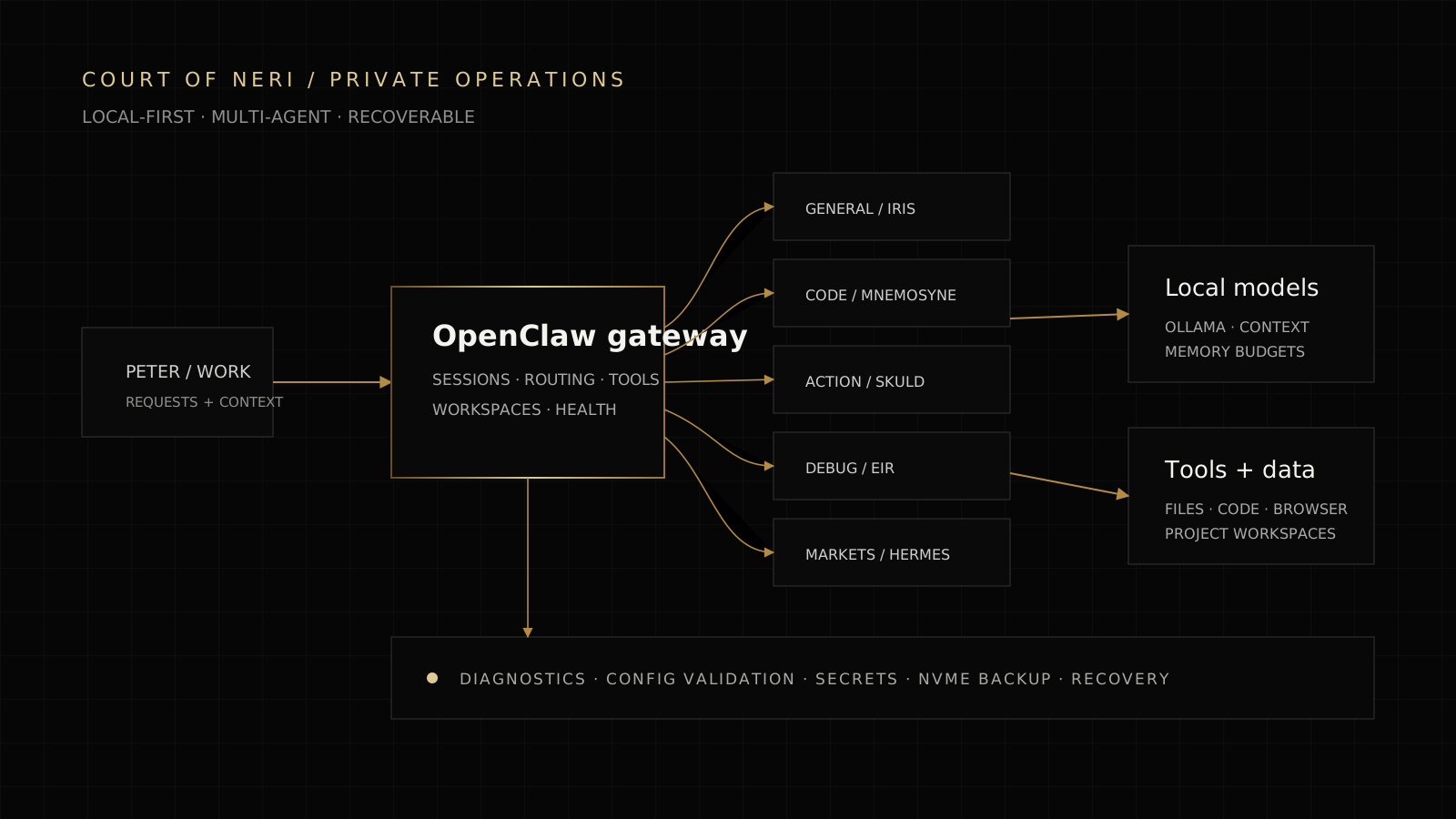
The Court of Neri was not created as a product. It is Trident’s internal operating environment: a local-first AI workshop that routes different kinds of work to specialized agents, models, tools, and project contexts while remaining inspectable and recoverable.
The operating problem
Standalone AI chats fragment context and encourage repeated setup. Coding, market analysis, debugging, research, visual work, and operations do not benefit from identical model settings or identical system instructions. A useful environment needs role separation, durable workspaces, controlled tools, and an operational recovery path.
The constraints
Local first
Substantial work should be possible on the studio’s own Apple Silicon hardware and NVMe-backed storage.
Specialized roles
General assistance, long-context coding, action execution, debugging, vision, and market analysis require different behavior.
Memory discipline
Model residency, context length, parallelism, and storage must fit a finite unified-memory budget.
Recoverability
Configuration, secrets, health checks, backups, and repair steps must be visible enough to survive failure.
The system
An OpenClaw gateway provides sessions, routing, workspaces, and tools. Specialized agents are mapped to local models through Ollama, with configuration tuned for the studio’s M1 Ultra unified-memory environment. Heavy model and project data live on external NVMe storage. Diagnostic, backup, secret-loading, and recovery scripts keep the environment operational rather than theatrical.
Named roles include a general assistant, long-context coding agent, action runner, debugger, vision role, and Hermes—the quantitative trading analyst used alongside TridentHydra.
Operational design
The Court includes explicit health commands, configuration validation, local workspace rules, memory-pressure awareness, storage diagnostics, backup scripts, and recovery ladders. It treats the AI layer as infrastructure that must be maintained, not a magic interface that can be trusted blindly.
The Court’s value is not the mythology of the names. It is the operating discipline underneath them.
Relevant applications
Private business AI
Role-specific local assistants connected to carefully selected tools and internal knowledge.
Small-team operations
Research, documentation, coding, monitoring, and follow-up distributed across controlled agent roles.
Technical studios
Cross-platform environments that must support code, design, data, and unusual project work.
AI readiness
A practical reference for the storage, recovery, security, and maintenance questions often ignored during deployment.
What the project demonstrates
The Court demonstrates Trident’s capacity to architect and operate private agentic infrastructure: model routing, context design, local compute, storage planning, diagnostics, secrets, backup, and recovery in one working environment.
Status: operational internal infrastructure. It is presented as proof of capability, not as a packaged commercial product.