
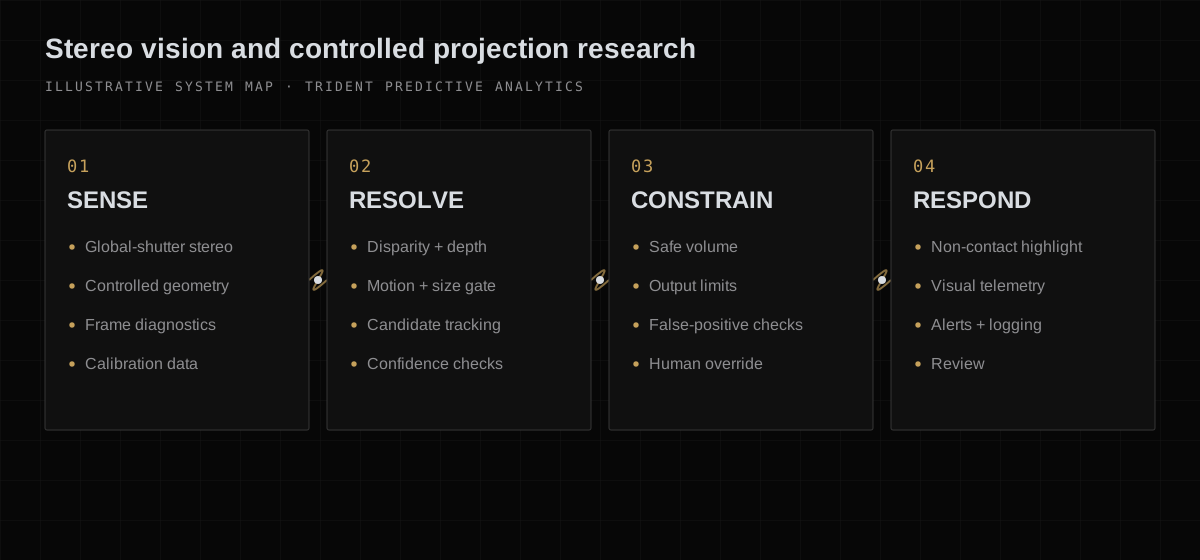
Tracking a small moving target is easy to describe and difficult to do honestly. The system must distinguish the target from noise, estimate where it is in space, remain fast enough to matter, and constrain any physical response to a safe operating envelope.
The problem
The research objective was a controlled, non-injurious system that could detect and highlight small airborne targets in a defined space. A single camera and a generic detector were not enough because distance, size, calibration, latency, and false positives all matter.
The constraints
Depth plausibility
Two-dimensional motion is insufficient when the system must know whether a target is inside a safe volume.
Small-target noise
Dust, compression, reflections, sensor artifacts, and background motion can resemble the target.
Projection calibration
Camera coordinates and projected coordinates must agree across the actual geometry.
Safety first
The response concept is highlighting and alerting—not injury—and requires explicit power, volume, and targeting constraints.
The system
The prototype combines a global-shutter stereo camera, GPU-capable edge compute, stereo calibration and depth estimation, motion and size gating, candidate tracking, confidence checks, and a separate projection-calibration pipeline. Diagnostic modes expose disparity scale, frame behavior, and calibration quality instead of concealing them behind one “detected” state.
The public case study intentionally omits sensitive implementation detail and focuses on the systems lesson: perception, geometry, timing, and output must be designed as one loop.
A safe physical system needs more than a positive classification. It needs spatial evidence, confidence limits, and a controlled response.
Use boundary
This is a safety-oriented research prototype for non-injurious highlighting and technical exploration. It is not offered as a weapon, autonomous targeting product, or permission to bypass applicable laser, privacy, facility, or electrical safety requirements.
Relevant applications
Research visualization
Show tracked motion and depth in a controlled experiment or educational environment.
Guided inspection
Highlight a detected location or region without requiring a person to watch every frame.
Interactive installations
Connect observed movement to spatial light, graphics, or responsive exhibit behavior.
Prototype sensing
Evaluate camera, calibration, compute, and latency before committing to a production architecture.
What the project demonstrates
The project demonstrates Trident’s ability to combine optics, stereo geometry, GPU compute, calibration, real-time software, diagnostic instrumentation, physical output, and safety thinking inside one unusual prototype.
Status: active laboratory research.